

No Deposit
Free Spins
Pay by Phone
OTT Voucher
Instant EFT
High Roller
Bonuses SA

Review:
by Joseph Stevenson
Salt Lake City, Utah, is the leading city of the US Inter-Mountain West, and possesses a unique setting and history. It was settled by members of the Latter-Day Saints (or Mormon) church who traveled there by wagon train in the 1940s in search of a livable isolated location where they could pursue their religion in peace. Singing their music of faith sustained them on the trip, and one of their first actions on settling in the Great Salt Lake Valley was to form a choral group, which became the Mormon Tabernacle Chorus. While many of the settlers had musical instruments, they did not have a local orchestra until 1892, when the Salt Lake symphony gave its one and only concert. In 1902, a Salt Lake Symphony Orchestra Association was formed, lasting for nine years. The next group, the Salt Lake Philharmonic, formed by an autonomous group of musicians, survived from 1913 to 1925.
The Great Depression forced many musicians on the relief rolls. The Federal Music Project of the Works Progress Administration appointed Reginald Beals to form an organization to employ indigent musicians. He started with a core of five players to form the Utah State Sinfonietta in 1935. It grew in size and in five years gave over a thousand concerts to a combine audience of nearly 350,000. When the temporary Depression project was phasing out, Salt Lake leaders decided to keep the orchestra in existence, and formed the Utah State Symphony Orchestra Association on April 4, 1940, giving its first concert five weeks later. Hans Heniot was the first music director.
The name was changed to the Utah Symphony in 1946. Werner Janssen was hired as conductor, but lasted only a year due to financial difficulties and the desire of the board to continue using predominantly Utah talent and to find a conductor who would commit to the orchestra wholly for as long as it took to build it into a solidly professional group. Maurice Abravanel, a pupil of Gustav Mahler, was that man. Hired to a one-year contract in 1947, he remained thirty-two years.
Despite periodic funding crises the orchestra survived and grew. It made history when it became the first orchestra to record a complete Mahler symphony cycle, accomplishing that feat in just one year. This was part of the Utah Symphony’s treasured series of nearly 120 recordings for Vanguard Records. The orchestra also recorded a remarkable range of music, including works by Milhaud, Var�se, Honegger, Satie, Gottschalk, and many other little-known works.
Abravanel was succeeded by Varujan Kojian (1979-1984), then by Joseph Silverstein (1983-1998). In 1998 Keith Lockhart became music director.
From 1946 to 1979 the orchestra performed in the Mormon Tabernacle. Seeking a venue to call its own, the orchestra succeeded in building a new Symphony Hall, completed for the 1979-1980 season. The acoustically superb building was renamed Abravanel Hall in 1993.
Track List:
1. 3:38 Overture: The World, The Flesh And The Devil
2. 15:04 New England Concerto
3. 3:27 Overture: Because of Him
4. 22:44 Spellbound Concerto
Link Removed
 (http://s1272.photobucket.com/user/relworp3/media/aa_zps05546061.jpg.html)

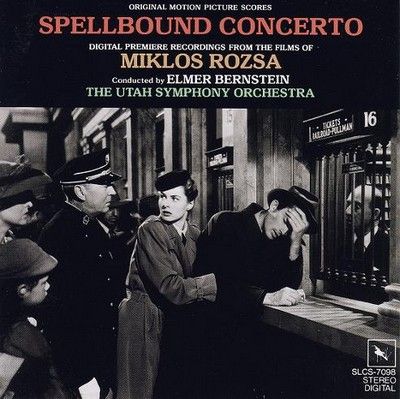
Spellbound Concerto (1945) (1992) Soundtrack Score
Composed by: Miklos Rozsa
MIRROR 320kbps: CONTACT ME
Tracklist:
01. Overture: The World, The Flesh And The Devil (03:31)
02. New England Concerto (14:57) based on themes from Lydia and Time Out Of Mind
03. Overture: Because Of Him (03:20)
04. Spellbound Concerto (22:42) 1984 version for two pianos and orchestra