

Low Wagering
Responsible Gambling
Prepaid Card
No Deposit
Free Spins
LOG and CUE files included. Do not share. Buy the original!
Please leave a "Like" or "Thank you" if you enjoyed this!
"My right arm is causing me a lot of trouble. I find it very difficult to write. During the summer I did,
however, write my Quartet No. 15, eleven Sonnets to poems by Michelangelo and some bits and pieces."
Dmitri Shostakovich, November 1, 1974.
The Suite on Poems by Michelangelo Buonarroti, Op. 145, originally scored for bass voice and piano,
was premiered in that form on December 23, 1974, by bass Evgeny Nesternko and pianist Evgeny
Shenderovich as an ideal double-bill to Mussorgsky’s Songs and Dances of Death. On January 8, 1975,
the work was played again in Shostakovich’s Moscow flat by the same duo for his colleagues. As
Shenderovich recalls, "The work left an overwhelming impression." Apparently, it was Aram Khachaturian
who asked Shostakovich if he intended to orchestrate the suite, to which Shostakovich replied that
he had no intention of doing so at the moment. Nevertheless, despite his rapidly declining health,
Shostakovich accomplished the orchestration sometime that spring. Unfortunately, he died on August 9,
1975, before the orchestral version of the suite could be premiered.
When interviewed the day after the premiere, Shostakovich described the suite as consisting of
"lyricism, and tragedy, and drama, and two ecstatic panegyrics in honor of Dante." In a later interview,
he said its subjects were "wisdom, love, creation, death, immortality." Shostakovich’s selection, his
grouping of the poems into three groups of three framed by a prelude and postlude, and most of all
his titles for the songs make those subjects explicit. "Truth" and "Immortality" frame "Morning"; "Love"
and "Parting" are followed by "Anger," "Dante," and "To an Exile," and close with "Creativity," "Night,"
and "Death." Although Shostakovich had taken on the subject of death many times since his first
heart attack in the spring of 1966, he had always railed against it with the greatest fury and horror.
But in the suite, Shostakovich’s bitterness receded and one senses in the music an acceptance and
even a transcendence of death.
The piano accompaniment of the suite was spare to the point of severity, matching perfectly the
austerity of Shostakovich’s setting. The orchestral version, while no less gaunt, has a much richer
range of colors and a much wider and deeper sonority. Perhaps unfairly, one might compare the
piano accompaniment to a pencil and wash drawing and the orchestral version to a fully rendered
oil painting. Certainly, the rage of "Anger" and the power of "Creativity" are much more forcefully
presented in the orchestral version while the supple tenderness of "Morning" and the nocturnal
fears of "Night" are more subtly nuanced. Of course, there is a loss of intimacy which, in a cycle
this profoundly personal, is deeply felt. Both versions are, each in their own way, ideal.
Shostakovich dedicated the suite to his wife, Irina.
The Four Verses by Captain Lebyadkin for bass and piano, Op. 146, were "bits and pieces"
Shostakovich composed in the summer of 1974 — the same summer he composed his String
Quartet in E flat minor, Op. 144, and his Suite on Texts by Michelangelo Buonarroti, Op. 145.
Unlike the harrowing death rattle of the quartet and the love and acceptance of the suite, Shostakovich’s
Lebyadkin Songs sneer at every emotion, disdain every ideal, and express hate for everything and
everyone – including the composer himself.
The Four Verses may seem ridiculous or repulsive, or even vile and evil — which, of course, they are.
To say that the Four Verses are merely the last in a long line of dissident rants against the Soviet state,
however, is too reductive. In the last summer of his life, in his final verse setting, Shostakovich denies
everything and everyone and embraces nihilism.
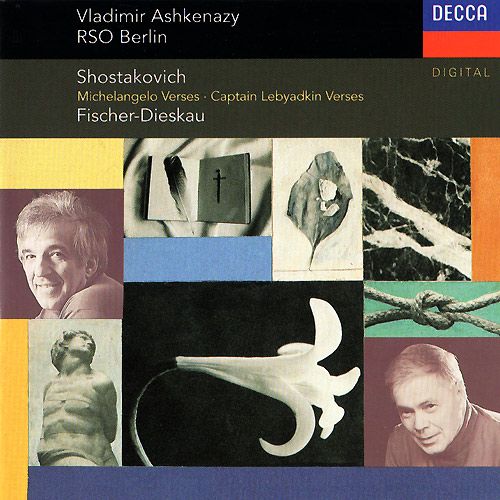
Music Composed by
Dmitri Shostakovich
Played by the
Deutsches Symphonie-Orchester Berlin
With
Dietrich Fischer-Dieskau (baritone)
Conducted by
Vladimir Ashkenazy
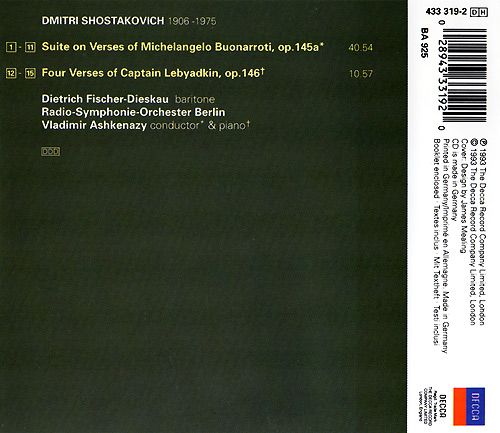
"What a phenomenon Fischer-Dieskau remains, at 68! In scrupulous Russian, always conveying
not merely the sounds but the full force of poetic sentiment, he delivers one of Shostakovich’s vocal
masterpieces, the setting of a Russian translation of 11 Michelangelo sonnets, and adds to it four
parodic, Mussorgsky-like songs on texts originally given to a character in Dostoevsky’s novel The
Possessed. The Michelangelo songs gain greatly in being performed not in the original voice and
piano form but in the composer’s own richly varied orchestration � with massive percussion where
the sculptor’s hammer is evoked. The Lebyadkin settings, unpublished until almost a decade after
the composer’s death in 1975, come with piano accompaniment. Both works were designed for
bass rather than baritone, and a few of the lowest notes in the Michelangelo settings emerge
slightly fuzzy. But these are nevertheless outstanding performances, the voice thrilling, the
accompaniments sharply illuminating, and the whole finely recorded. Text is provided, but
not the date of recording � and surely more music could have been added to make up this
disc to a reasonable length."
Arthur Jacobs, BBC Music Magazine
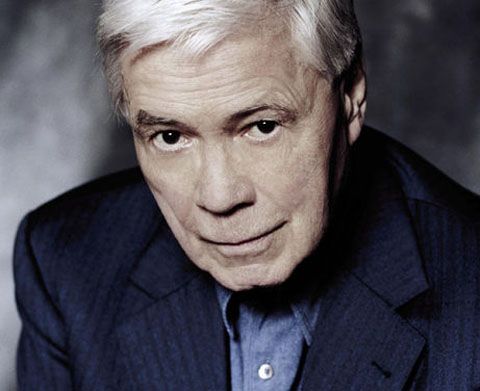
Download Link – https://mega.co.nz/#!6Jg12IQR!8BM0Ljktk8cMYpxRCKlXkpjlvMYsIBkSIztap6w JL0E
Source: Decca CD, 1993 (my rip!)
Format: FLAC(RAR), DDD Stereo, Level: -5
File Size: 254 MB (incl. artwork, booklet, log & cue)
Enjoy! Don’t share! Buy the origina! Please leave a "Like" or "Thank you" if you enjoyed this! 🙂