

Low Wagering
Responsible Gambling
Prepaid Card
No Deposit
Free Spins
LOG and CUE files included. Do not share. Buy the original!
Please leave a "Like" or "Thank you" if you enjoyed this!
Sergei Prokofiev was a versatile composer who wrote substantial quantities of music in almost
every major genre. There was an exception of sorts: while his chamber output was not particularly paltry,
it was not large, either. There are only two string quartets, for instance, and this Op. 50 effort did not
come until mid-career.
Written on a commission from the Library of Congress, the String Quartet No.1 is regarded by many
as one of Prokofiev’s greatest masterpieces. The finale especially has been widely praised as one of the
most profound movements he ever composed. The work has an unusual structure: the first two
movements are generally lively, while the finale is slow and somber. The opening movement, marked
Allegro, begins with a brisk, strongly accented theme that leaps about almost spastically. An alternate
melody of lyrical character contrasts with it. The stormy development section is brilliantly crafted in
its intensity and subtle thematic elaborations. The reprise features many imaginative changes in the
material, and the movement ends with a sense of urgency.
The middle movement (Andante molto — Vivace) starts off slowly and somberly, but suddenly turns
animated, bringing on a mischievous and somewhat harried Scherzo. The music mixes energy and
playfulness, yielding a humorous, sassy piece of great color. The Andante finale is dark and intense
and features themes of considerable depth, from the terse mysterious opening to the long-breathed
main theme that pours forth sadness and gloom, then turns briefly sweet. The music becomes more
animated and intense after the expository section, but its conflicts are never resolved. The movement
ends quietly, fading in a sort of gloomy, mesmeric trance.
The parenthetical subtitle here, "Kabardinian," refers to the origin of the themes in String
Quartet No.2. Prokofiev rarely used folk or other unoriginal thematic material in his works.
This F major Quartet was an exception. In 1941 the composer, along with Myaskovsky and other
artists, was sent away from Moscow — towards which Hitler’s troops advanced — to the safer
haven of Nalchik, capital city of the Kabarda-Balkar Republic, situated in the Northern Caucasus.
There he was exposed to, and ultimately fascinated by, the folk music of that region.
While experienced listeners will hear the folk-flavor in the themes of this quartet (especially in
the second movement), they will at once recognize the music as pure Prokofiev. The tenor of
the work is light, from the rhythmic gusto of the first movement to the chipper prance of the
finale. The opening panel, marked Allegro sostenuto, features two colorful themes, both lively
and rhythmic, the second of the pair more genial and catchy. While the development section
works up considerable tension and conflict, the music in general remains light and playful.
The second movement Adagio begins with an exotic melody which has a Middle-Eastern air
about its quivering accompaniment. A playful theme that skips about to an array of rhythmic
effects forms the delightful middle section. The opening theme is reprised and the music
ends quietly. The finale, marked Allegro, presents a catchy rhythmic theme and an alternate
exotic melody, whose accompaniment features colorful prickly jabs. The middle section is
largely comprised of a sustained emotional outburst whose cries are the only sounds in the
work that even vaguely hint at war or suffering. The main material returns in reverse order
and the works ends happily.
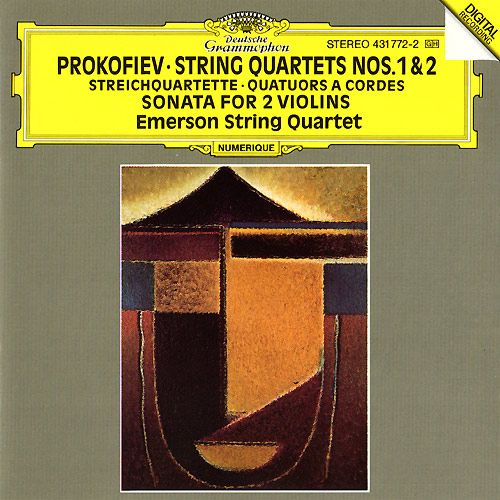
Music Composed by
Sergei Prokofiev
Played by the
Emerson String Quartet
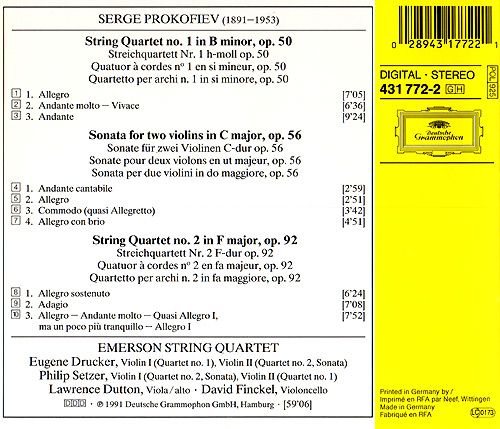
"Sergei Prokofiev does not come to mind as a string quartet writer but his two attempts
in that form are interesting and engaging works. The First Quartet was written on a commission
from the Library of Congress for their chamber music concerts in 1930. The quartet became
the last work of Prokofiev to be premiered in the West.
Both of the Quartets are in three movements. The First Quartet is characterized by catchy
melodies and quick tempi in the first two movements concluded with an introspective Andante
that remains inward looking until the quartet quietly concludes. The Sonata for Two Violins,
from 1932, is cast in four short movements and is more typically caustic for Prokofiev that
the First Quartet. After a brief and quiet introduction, the violins engage in a sharp exchange
in the second movement. The third movement returns to the introspection of the first and
the Allegro con brio finale is a happy duel between the violinists that becomes more lyrical.
Prokofiev’s final quartet was written in 1941 after he had been evacuated during the Second
World War. The Second Quartet was based on Caucasian melodies. The quartet is simply
written and appealing. The first movement has some beautiful melodious and the second,
an Adagio, is wonderfully animated particularly in the play of instruments in the pizzicato
section. The final movement is based on a dance tune that brings the quartet to a brilliant
conclusion.
The Emerson Quartet plays the Sonata and the Quartets beautifully and while these may
not be among the best of Prokofiev’s works they are richly textured and melodic. The
recording is nicely balance and clear. An interesting disc if you are interested in Prokofiev
and string quartets."
Amazon Reviewer
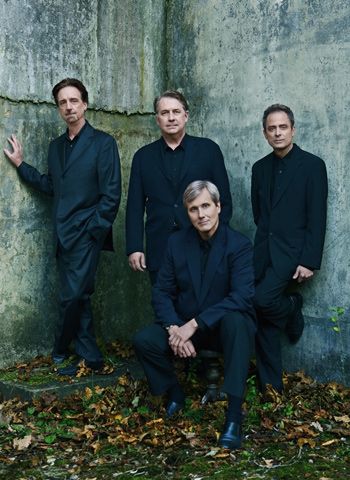
Download Link – https://mega.co.nz/#!XYgzTYYa!hb0S-MNlBVGEZEplXLCUpW_vPu5vu_MZE-zY2Au-7vs
Source: Deutsche Grammophon CD, 1991 (my rip!)
Format: FLAC(RAR), DDD Stereo, Level: -5
File Size: 318 MB (incl. artwork, booklet, log & cue)
Enjoy! Don’t share! Buy the origina! Please leave a "Like" or "Thank you" if you enjoyed this! 🙂