

Low Wagering
Responsible Gambling
Prepaid Card
No Deposit
Free Spins
LOG and CUE files included. Do not share. Buy the original!
Please leave a "Like" or "Thank you" if you enjoyed this!
Just as Igor Stravinsky’s 1930 Symphony of Psalms bears a dual dedication to God and the
Boston Symphony Orchestra on its fiftieth anniversary, so does the title-page of the Symphony in C from
ten years later, describing the work as having been "composed to the glory of God, [and] dedicated to the
Chicago Symphony Orchestra on the occasion of the Fiftieth Anniversary of its existence." The commission
had been offered to Stravinsky by Mrs. Robert Woods Bliss on behalf of the Chicago Symphony Orchestra
in 1938, but it was not until November of 1940, with Stravinsky conducting, that the Orchestra could give
the world premiere of the finished work. For, while the commission was certainly a welcome one, the actual
progress of the work was interrupted first by a series of personal tragedies — the deaths of his wife, daughter
and mother, during 1938 and 1939 — and then, of course, by the outbreak of war in late 1939 that precipitated
Stravinsky’s emigration to California. The Symphony in C, then, is a composition whose four movements
were composed in four different cities and two continents over a span of just under two years.
If the years between 1938 and 1940 were turbulent ones for both Stravinsky and the community of nations
around the world, it doesn’t show in the work: here is pure music, unruffled by the dynamics of personal
emotion and, following Stravinsky’s heartfelt beliefs on the subject, making absolutely no pretense at
expressing anything except the fundamental drives of a composer struggling to come to grips, really for
the first time in his life, with symphonic form. Stravinsky himself felt that there is some stylistic difference
between the first half of the work, composed in Paris and Sancellmoz, and the second half, composed in
Massachusetts and California, but these distinctions of direction (or perhaps taste) are, after all is said and
done, relatively minor, and in performance the Symphony comes across as essentially a very well-unified
body of music.
Stravinsky completed his Symphony in Three Movements in 1945. The first movement was begun in
April 1942, and the final work was completed a few months after the end of World War II. During this
time the composer was engaged in contract negotiations to write film scores. Among the film moguls
interested in commissioning Stravinsky was Louis B. Mayer, then president of MGM. Stravinsky had
already written music before the projects were scrapped, and much of it found its way into Symphony
in Three Movements. The outer movements involved wartime news footage, and the central movement
was written for the appearance of the Virgin Mary in the film The Song of Bernadette, based on
the Franz Werfel novel.
To integrate the different groups of material, Stravinsky chose to feature the piano and harp in separate,
concertante roles in the first two movements, and then combined them in the third movement in an
extended fugal arrangement. The symphony is a great balancing act, weaving together disparate
musical ideas. The outer movements are explosive, indicative of the film score style common to
American war footage. Ironic artifice, a signature sound in his music, is particularly understated in
this symphony. Likewise, the middle movement, originally intended for the Virgin apparition, is
suitably wrought with veneration, though perhaps not to the extent that would have please the film’s
producers. Stravinsky was not the sort of composer who gushed excessively, if at all. His Symphonies
of Wind Instruments was an elegy of Debussy’s passing, a composer and friend of enormous
importance to Stravinsky, but any lamentations in the work are under total control. It was not in his
character to express his feelings musically, and in fact, felt that musical was incapable of "expressing"
anything. That being the case, for him to depict Bernadette’s shock and amazement at encountering
the Mother of Christ would have sounded unnatural. The central movement is not rhapsodic or indicative
of a human soul overwhelmed in the presence of a divine being. It is contemplative music, subtle
and understated, and free of amazement. The outer movements are somewhat more successful in
capturing the intended spirit of war footage. They feature tumultuous blasts of brass and driving
rhythms but again the composer seems removed from the excitement and concern the music is
supposed to convey, instead sounding rather bizarre and exotic. The focused intensity of a believer
in either war or religion was too singular a nuance for Stravinsky to sustain for an entire film score.
Ultimately, the result of this forgivable failing was an excellent and memorable symphony.
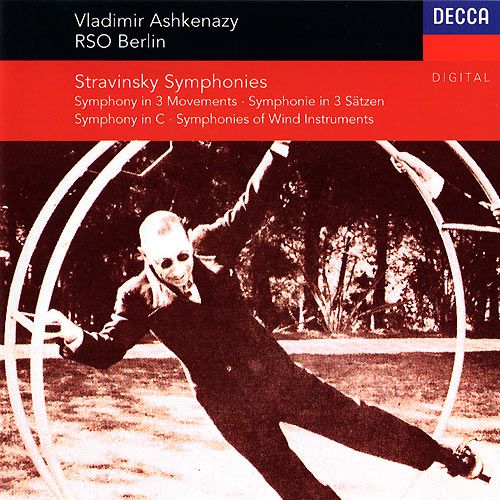
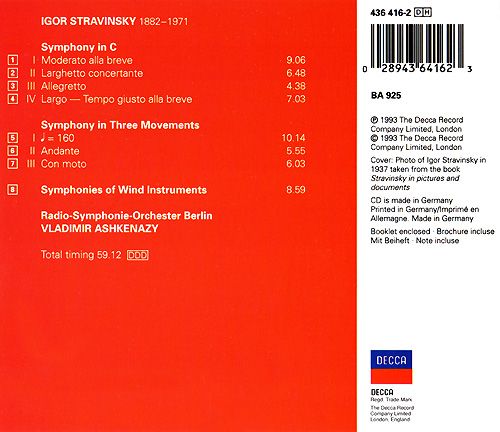
Music Composed by
Igor Stravinsky
Played by the
Deutsches Symphonie-Orchester Berlin
Conducted by
Vladimir Ashkenazy
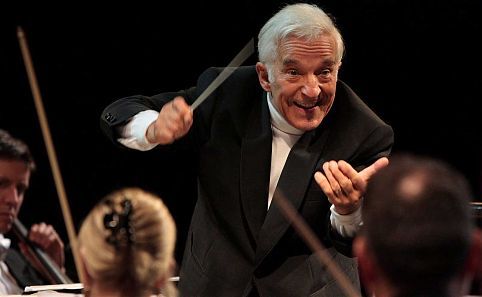
"Dutoit, Gibson and Saraste currently offer Stravinsky’s two mature, purely orchestral symphonies
together; and the composer’s own account of the Symphony in Three Movements � now obtainable
with all three of his other works titled ‘symphony’ on two CDs from Sony � has been particularly
praised. But Ashkenazy obtains delightfully vivacious, pungent, occasionally downright cheeky
playing for the Symphony in C � which demands, and here receives, razor-sharp orchestral
virtuosity and careful shaping as well as playfulness. Energy and precision seemed just a bit lower
at the start of the Symphony in Three Movements. But I like the brittle, almost menacing pianist.
And woodwind, harp, horn and solo strings in the slow movement are beautifully etched.
Good recordings."
BBC Music Magazine
DOWNLOAD LINK (FLAC) – https://mega.co.nz/#!6RZRmAwa!u09auAMYChut_WvUaedjxgRYguFStiOyrCR-1buaOsg
Source: Decca CD, 1993 (my rip!)
Format: FLAC(RAR), DDD Stereo, Level: -5
File Size: 238 MB (incl. artwork, booklet, log & cue)
Enjoy! Don’t share! Buy the origina! Please leave a "Like" or "Thank you" if you enjoyed this! 🙂